What age should a kid get their first phone?
Most parents start asking this question somewhere between their child’s seventh and tenth birthday. The answer they are looking for — a specific number — does not exist. But the framework for making a good decision does, and it is less complicated than the internet makes it seem.
Why age is the wrong question
Child-development research does not cluster around a single age for phone readiness the way it does for, say, reading or bike riding. The American Academy of Pediatrics stopped publishing a recommended age for smartphones in 2016 precisely because the right answer depends too much on the individual child and the type of device. A 7-year-old who walks to school alone has a different need than a 12-year-old who is still driven everywhere.
The more useful question is: what problem are you actually trying to solve?
- Your child needs to be able to reach you (or a trusted adult) from home, or from a friend’s house — but they don’t go anywhere independently yet.
- Your child is starting to move around the neighborhood without you and needs a way to check in from wherever they are.
- A grandparent, divorced parent, or close family member lives far away and wants to stay in regular contact.
- Your child’s school or after-school program expects reachability by a certain grade.
Each of these problems has a different right answer — and the answer is not always “get a smartphone.”
The two common decision points
In practice, most families face a phone decision at one of two moments:
Ages 6–9: the home-phone window
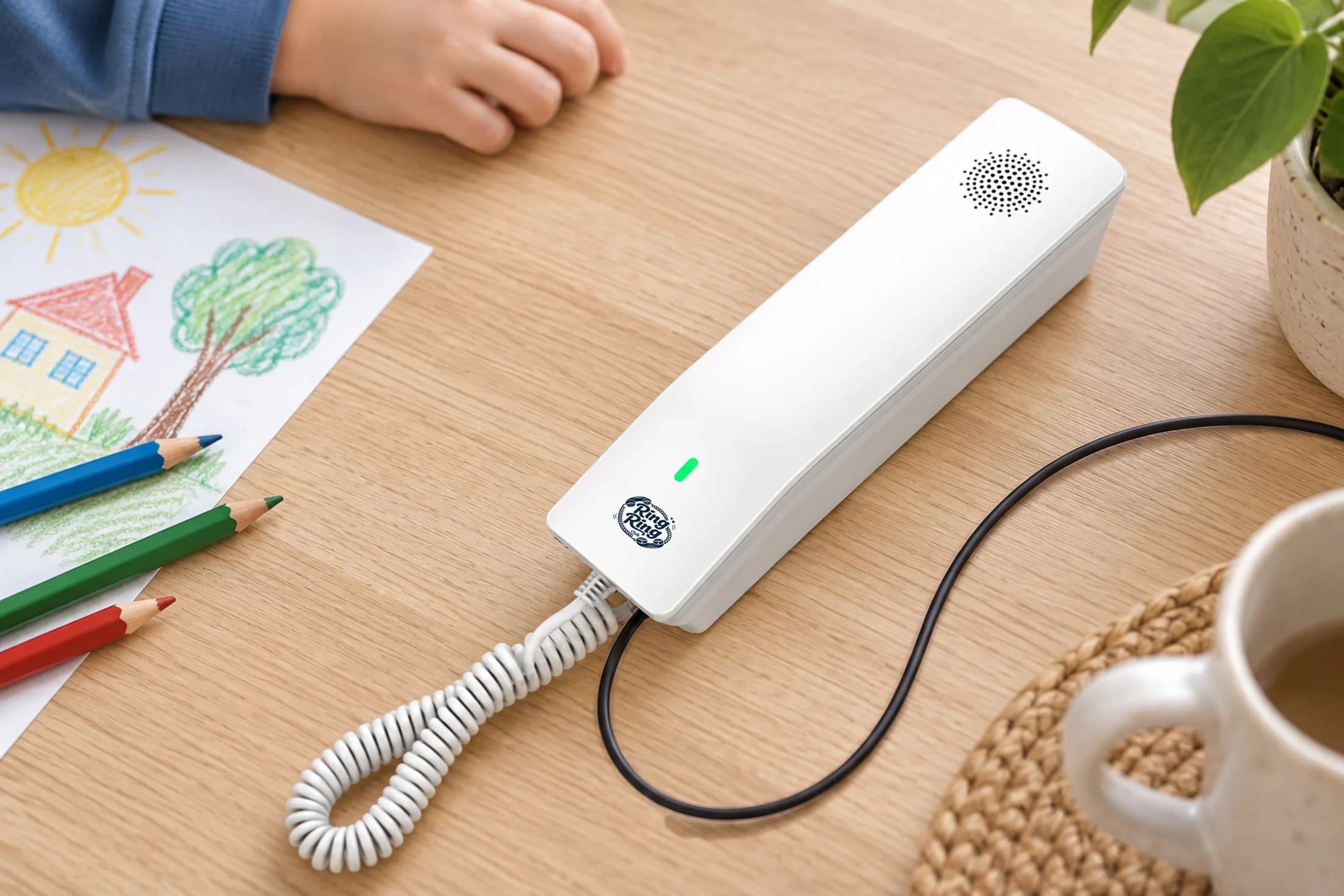
Kids this age are starting to call friends and grandparents, or are home alone for short stretches for the first time. What they need is a way to make and receive calls from home — not a device they carry. A home phone (which can be a screen-free Wi-Fi phone like Ring Ring, not necessarily a landline) solves the problem without introducing a screen or opening the internet to them. The cost is low, the setup is simple, and the habit it builds — picking up the phone and having a real conversation — is genuinely valuable.
Ages 10–13: the carry phone question
By middle school, kids often need a phone they can take with them. At this point many parents reach for a smartphone — but this is the moment where the decision has the most long-term consequences. Research from the Journal of the Association for Consumer Research (2017) found that the mere presence of a smartphone on a desk — even face-down — reduced available cognitive capacity in college students. Younger brains are considerably more susceptible to that pull. Pediatric psychiatrists like Dr. Jean Twenge (author of iGen) have documented a sharp inflection in adolescent anxiety and depression coinciding with the smartphone adoption curve between 2012 and 2015.
That does not mean your 11-year-old cannot handle a phone. It means the type of phone matters as much as the timing.
What the research actually says
The clearest signal in the literature is not about age — it is about apps and social media. Studies consistently show that passive social-media use (scrolling, comparing) correlates with poorer mental health outcomes in adolescents, with girls 10–14 showing the strongest effect. Calling and texting, by contrast, show no negative correlation and in some studies a modest positive one (kids who talk to family members regularly report higher wellbeing scores).
The practical takeaway for parents: a phone that only calls is materially different, in developmental terms, from a phone that also browses Instagram. Conflating the two is what makes the “what age?” question so difficult to answer.
Readiness signals worth looking for
Rather than a specific age, watch for these:
- They are going places without you. Walking to a friend’s house, riding bikes around the block, staying home for an hour or two — any of these create a legitimate communication need.
- They are asking to call specific people. “Can I call Maya?” is different from “can I have a phone?” The first is a communication request; the second is usually a social-status request.
- They have people who want to reach them. A grandparent in another state, a divorced parent who doesn’t live at home, an aunt who calls on birthdays — these relationships strengthen when there is a direct line.
- You are running your phone as a relay. If you are constantly passing your phone to your child so they can talk to someone, a phone of their own is overdue.
The type of phone changes everything
Once you decide a phone makes sense, there are three honest categories to choose from:
- A screen-free home phone. Lives at home, no apps, no browser. Works over Wi-Fi. Best for the 6–9 window when kids don’t need to carry it yet. This is what Ring Ring is — see our first-phone guide for a full comparison.
- A purpose-built kids smartphone. Gabb, Pinwheel, Bark Phone — designed to be carried, with parental controls built in. Appropriate when genuine portability is the core need. Plans run $20–$30/mo.
- A restricted hand-me-down. Old iPhone with Screen Time, no SIM. Good for Wi-Fi FaceTime at home; poor at creating call habits; parents consistently report Screen Time is hard to enforce.
If keeping screens out of the picture is important to you, our screen-free phone guide walks through the options in detail. If cost is a factor, the affordable kids phone guide breaks down what things actually cost across all three categories.
A note on the social pressure
“But everyone in my class has a phone.” This is the argument that causes the most parental capitulation, and it is almost never accurate. A 2023 Pew Research survey found that 43% of children ages 8–11 do not have a smartphone. Among elementary schoolers the majority still don’t have one. Among middle schoolers who do, their parents consistently report wishing they had waited.
Giving a child a phone that rings — and being straightforward about why — is a defensible choice that most kids can explain to their friends without embarrassment, especially if the phone is presented as its own thing (a real phone, with a real number) rather than as a downgrade.
The honest short answer
If your child is 6–9 and the need is home communication: a screen-free home phone now is better than a smartphone later for no reason. If your child is 10–13 and genuinely needs portability: a purpose-built kids smartphone is a better choice than an unrestricted hand-me-down. In either case, a phone that just calls creates better habits than a phone that does everything, and the habits you set in the first year tend to stick.
The specific age matters less than you think. The type of device matters more than most parents realize until after the fact.
Keep reading
- Turn any old phone into a working phone for your kid — even a thrift-store rotaryThat old corded handset in the back of the closet (or on a thrift-store shelf for $4) can become a real, working phone for your child in about 20 minutes. Here is how.
- Screen-free phones for kids: the honest alternatives (2026)Six real options for parents who want their child to be reachable without handing them a smartphone. Prices, tradeoffs, and who each option fits best.
- How to set up a Wi-Fi landline for kids (step by step)A practical walkthrough for parents who want a home phone for their child without a phone-company landline. No new wiring, no monthly phone bill.